Red Moon
Kim Stanley Robinson
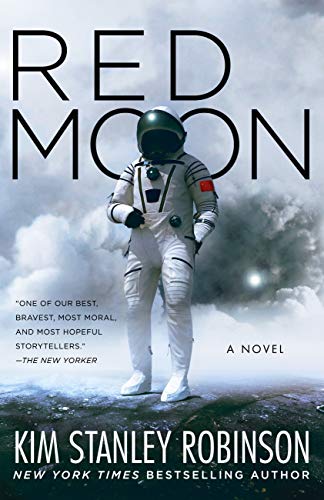
KSR take a little trot out to the moon and back (several times) to exercise some of his areas of interest: economoics, politics, space travel, AI blended together in a neat near-future package that delivers both too much and too little. His writing style is deceptively simplistic, but when it works well he can tackle some sophisticated themes very effectively. It’s clearly a choice as some of the ‘AI thinking’ chapters are complex, almost baroque.
Construction cranes poked the gray night sky like giant gallows built to hang any surviving remnants of Nature.
“Do you know about the hukou system?”
“In China, where you are born determines your whole life. You’re assigned a household registration tied to your birthplace, and that’s the only place you can legally live, unless you get registered somewhere else by getting a registered job, or getting into a school. But those are hard things to get, and most people have to stay where they were born. So if you’re born out in the country, that’s it. And life there is so hard it’s almost like the Middle Ages. Subsistence farming, not much money, not much to do. People go hungry there, sometimes. So lots of people leave their legal residence and come to the cities to find work. Those are the migrants.”
“Are there a lot of them?” She gave him one of her hard looks. “Five hundred million people, is that a lot?”
“Um, yes.”“One-third of all Chinese. More than all the people in America.”
Polyarchies are better because power gets distributed to various groups. They’re inefficient and messy, with lots of turf battles, but that’s the cost of distributing power. It’s better than concentrated power.”
“Blockchain governance? Meaning what?” “All our activities and decisions are recorded in a secure distributed network, including our comings and goings, but also everything we do as a town. We call it documented anarchy. A full-disclosure commons. Anyone can do anything, but everyone gets to know what that is.”
Across the lake the monkeys were carefully rolling a bicycle into the water.
The sheer desolation of the moon. The nihilism of no nature, no life. A dead world. A dead world that could kill you at any moment.
Ninety-five percent of the Chinese population lived on the third of China that lay to the southeast of the Hu Line, five percent lived on the two-thirds of the country to the northwest of the line. That was strange, though perhaps it only marked how much people needed to live by water and fertile soil. This too was feng shui; wind and water made all the difference.
He was reminded that some impacts were so violent they changed everything, even the axis of the world. This feng shui perception, mixing geology and deep time into a history of everything, overwhelmed him: they were in it, they were part of it even now, or especially now. A bang like this could happen to them.
But now it appeared that everywhere in the world governments were suffering a crisis of representation. Possibly this was because it was all one system, which one could call global capitalism with national characteristics, each variation around the Earth marked by the remaining vestiges of an earlier nation-state system, but still making together one larger global thing: capitalism. When it came to those national characteristics, China had the Party, the US its federal government, the EU its union; but all were ruled by the globalized market.
Food, water, shelter, clothing, healthcare, education: these all need to be adequate for everyone alive, before anything else good can happen.