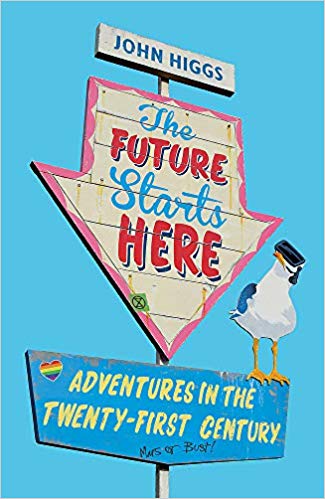
The Future Starts Here
Adventures in the Twenty-First Century
John Higgs
Inspiring. Pragmatic optimism.
When the post- apocalyptic Australian film Mad Max 2 was produced in 1981, it was necessary to explain to the audience why civilisation had collapsed.
When the Sex Pistols emerged like harbingers of an unwelcome nightmare and announced that we had ‘no future’, that was really shocking.
Between 100,000 and 50,000 years ago, something about our ancestors changed. Anthropologists call this change ‘behavioural modernity’, and the Israeli historian Yuval Noah Harari calls it ‘the cognitive revolution’. Either the arrival of language or a mental change that allowed the development of language took us out of the natural, animal world and made humans different from the rest of the fauna.
The Stadel Lion Man is the first unreal, imagined thing to manifest in the archaeological record.
In the millennia since the carving of the Stadel Lion Man, we have moved out of the material world and into an immaterial one.
Lending money, and expecting to receive a larger sum in return thanks to interest, can only occur when it is believed the economy of the future will be larger than the economy of the present.
This circumambient mythos is the reason why we automatically speak of ‘technological advancement’ instead of the more accurate ‘technological change’, even when we know that new technology does not necessarily make our society better. The
As Booker describes comedy, ‘the essence of the story is always that: (1) we see a world in which people have passed under a shadow of confusion, uncertainty and frustration, and are shut off from one another; (2) the confusion gets worse until the pressure of darkness is at its most acute and everyone is in a nightmarish tangle; (3) finally, with the coming to light of things not previously recognised, perceptions are dramatically changed. The shadows are dispelled, the situation is miraculously transformed and the little world is brought together in a state of joyful union.’ We think that the plot we are enacting is tragedy, but it could equally be the second part of Booker’s definition of comedy. If there is a shift in perception coming that would reveal the plot as comedy, we would, by definition, be blind to it.
I have lucked out and I know it. There is no place I’d rather be than where I live.
But reality is a Rorschach test: what you see reveals more about you than it does about reality.
What’s needed is pragmatic optimism. To be a pragmatic optimist, it is necessary to look the future in the eye, to truly understand the problems ahead and then adopt an optimistic approach regardless.
The trick is to keep an optimistic mind about the approach, not the outcome.
The coming years, we are told, will be a time of artificial intelligence, big data, virtual reality, space exploration, mass unemployment and environmental collapse. I will need to understand these subjects better, because that is the way of the pragmatic optimist.
If a robot- led productivity revolution was on its way, you would expect to see high levels of investment, high returns on capital and high long- term interest rates. But there is little sign of such things, over the next ten years at least.
The machine was going to a lot of trouble to mimic what it had been trained to copy, but it was doing so without any larger sense of meaning or purpose. It was the literary equivalent of an X- Factor contestant.
One definition of AI, then, is things that computers can’t quite do yet. AI is like the end of the rainbow, a receding goal you can never quite reach.
A tiny web of neurons can be sufficient to intelligently control a living creature. The brain of a roundworm contains just 302 neurons, for example.
If we did ever succeed in one day building a conscious super-intelligence, I would not be surprised if the machine’s first act was to turn itself off.
A truism used in the data industry is that faith in data grows in relation to your distance from the collection of it. A statistic always sounds more convincing the less you know about where it came from.
What usually happens is that new discoveries lead us to problems that we hadn’t been aware of previously.
The non-ironic sincerity of Millennials has been confusing to postmodern Generation Xers, who dismissed sincerity and couldn’t grasp the concept of its return, but it has particularly annoyed Baby Boomers.
For those raised in the circumambient mythos of the postmodern late-twentieth-century West, there is no meaning to be found in the world. Anyone who thinks otherwise is considered delusional, which is an attitude taken to its extreme by the angry-old-man atheist movement. But to Millennials meaning is something subjective rather than objective. This was how they were able to resurrect the concept after it had been so firmly refuted by the nihilistic Generation X. As the Millennial generation understands the world, if they find something personally meaningful then that means that there is meaning in the world. Surely finding value in obsessive attention to a well-groomed beard was an improvement on Kurt Cobain-style nihilism?
It does not help that Generation Z are so strangely contradictory, being both extremely liberal and extremely conservative at the same time. They fiercely reject any inequality based on race, gender or sexual orientation, but they respect authority, are obsessed with safety and fear economic uncertainty. They show great empathy for others but suffer from social anxiety to the extent that they will go to great lengths to avoid face-to-face communication with strangers.
In contrast, the phrase ‘my friendship group’ takes the focus away from you and focuses on the wider group of connected people, of which you are just one. It understands the shifts in dynamics when a new person is admitted into the group on a deeper level than just your personal connection to that person. The phrase recognises relationships between your friends which don’t necessarily involve you
Mankind’s metaxy, Plato explained, was to be between the animal world and the immaterial world of spirits and gods.
The vast majority of wealth being created by the workers of the world started flowing to a tiny number of transnational billionaires, and there was little that nation states could do to stop this. Anger at this situation led to a rejection of the centrist political position that had dominated during the last years of the twentieth century, because centrists had sat back, allowed it to happen, and had nothing to offer in terms of fixing the problem. Instead, there was an embracing of left-wing and right-wing positions that had previously been seen as extreme. The right attempted to fix the position by reinforcing sovereignty and the power of nation states, while the left attempted to strengthen workers’ positions at the expense of corporations. Both positions have been criticised as attempts to roll the clock back to a time that has now gone, and both can be seen as flawed and potentially dangerous. Such is the metamodern world: we oscillate between extreme opposites because the seas are turbulent and the still point at the centre is no longer an option.
A useful way to think about this is to recall something you have fallen back in love with, be that a band, an artist or even a person. When you first discovered a favourite band, you found part of what they do immediately attractive or intriguing. This is what held your attention as you got to understand their body of work better. In time, however, you saw past what appealed to you in the first place and began to see the band’s limitations. This changed how you thought about them and stopped you loving them quite so unquestioningly. It could lead you to stop listening to their albums, perhaps even for decades. But, in time, if you then went on to revisit them, you did so aware of both their appeal and their weaknesses. Your view of them was based on a full, rounded understanding of who they were, both good and bad, not just a fixation on their superficial appeal. If you found that you still loved them after that, then it was a deeper love than before. Once you had the level of understanding that comes from knowing both the strengths and weaknesses of something, you would not want to go back to insisting that only the good exists.
To a fundamentalist, living in a metamodern world must be horrible. Many of the convulsions we are seeing in fundamentalist religious, political and cultural movements around the world are reactions to our increasingly metamodern culture.
The use of irony like this is a step beyond Millennial culture’s love of authenticity. That Generation Z have found a valid, practical use for irony shows how much they have progressed over Generation X.
We are not in a tragedy, I realised at that moment. I’m sure I can hear a laugh track. This is definitely a comedy.
Even if an atomic war triggered a nuclear winter, does it make sense to move over 30 million miles to somewhere that also has unsafe radiation levels and is too cold for human life?
Imagine if life on Earth became so perilous that it became necessary for a million survivors to move to the unspoiled continent of Antarctica and live in tunnels underground. This would not strike many people as an appealing way to spend the rest of their days, but it would offer a far greater quality of life than living underground on Mars. The air contains oxygen and would be breathable, the temperature is warmer, water would be easy to obtain, the ground is not full of poisonous perchlorates, sufficient quantities of nitrogen exist on the same planet, radiation isn’t a problem and you would not suffer the many and varied medical conditions caused by low g
Humans evolved alongside a symphony of flora and fauna in the thin damp band of atmosphere that clings to this planet. It is the only known place in the universe where we can survive.
Humanity is part of planet Earth’s ecosystem, and we will die if taken outside of it.
We are going to have to make this work. We’re going to have to remain here sustainably
When we think of the future, we need to think of the human world, the natural world and the digital world as being co-dependent and predominantly earthbound. All three live on this rock, and we will all have to get along.
Sitcom, then, is the best metaphor for our future. Humanity, our digital creations and mother nature attempt to get along, while trapped together on the third rock from the sun for untold years to come. Would that be so bad?
Facebook seems to have realised that the very things which made it one of the most successful companies in the world are exactly the reasons why post-Millennials want nothing to do with it.
Once again, a long-established practice only became seen as unacceptable when it was industrialised and massively expanded.
most dystopian futures assume that we keep on doing all the things that are bad for us.
difficult. In circumstances like these, you may assume that it will take a massive escalation in extreme weather and climate chaos in order for us to change course, in a similar way to how slavery and European war became unthinkable after they were industrialised. The problem is that by the time we get to that point, it will be too late.
The awareness of what makes nature sacred is what separates us from it. There is no way to square this circle. It is like the grief felt at the loss of a loved one, in that there is no way to make it right. It can only be lived with, and this will be hard. The Dark Mountain Project, if seen in these terms, is hard to criticise. Giving up eventually becomes inevitable when what you seek can never be found.
Trees covered 7 per cent of England in 1980, for example, but that has since risen to 8.4 per cent and is increasing rapidly.
Half-Earth changes this, defining us as nature’s equal. Digitally enhanced mankind and nature are the dual inhabitants of Earth. They are not slave and master, but instead must try to live together in a sustainable partnership.
‘The prisoner who had lost faith in the future – his future – was doomed. With his loss of belief in the future, he also lost his spiritual hold; he let himself decline and became subject to mental and physical decay. Usually this happened quite suddenly, in the form of a crisis, the symptoms of which were familiar to the experienced camp inmate.’
To those of us raised in the twentieth century, unable to imagine a better future, it is hard to imagine that we will change. But that is a quirk of the age we have lived through. Our vision has been reduced by the dark cloud we were unlucky enough to grow up under.
This shift from geniuses to sceniuses, not just in music but in all aspects of human endeavour, neatly sums up the difference between the individualistic twentieth century and the networked twenty-first.
From our films, commentators and social media, I had thought that a collapse was coming, and the only question was when. Now, I think that I happened to be born just as a wave of nihilism was washing over our culture. That wave blinded my generation and prevented us from seeing what was ahead. This wave, I think, is starting to recede. To give one small but telling example, the fact that no film or TV company had ever tried to adapt Iain M. Banks’s hugely influential Culture series of novels always felt significant. Banks’s future Utopia was too much at odds with the circumambient mythos to risk spending millions of dollars filming them. But in February 2018 Amazon’s CEO, Jeff Bezos, announced that Amazon Studios would adapt the books, claiming that he himself was a massive fan. This is just a small incident, of course, but if you look at Generation Z culture you will find many such small incidents. It does seem that a new circumambient mythos is forming.
The attributes that will be most useful are creativity, imagination and playfulness, combined as always with fidelity and tenacity.
This is the last stand of the individualistic, fundamentalist, single-vision philosophy, which calls for walls and isolation like Canute ordering back the waves. The young are watching all this play out. They are not seeing anything that appeals. They are certainly not seeing anything that works.
Sometimes, a virus has to run its course before you can be cured. Some ideologies need to reach their failed, absurd ends before we can get them out of our system. This is how we create the antibodies that will protect us from that virus in the future. That’s what’s happening now. It’s not fun, but it’s probably necessary. It will be worth it in the end, in the future that we are all building together, whether we deny it or not.